If a song uses a Western musical genre, is written by international producers,
contains English lyrics and is performed by multinational idols, why is it still
called K-pop?
Move your cursor to trace the visual language of K-pop
What is the most important factor in defining K-pop?
03 / Definition
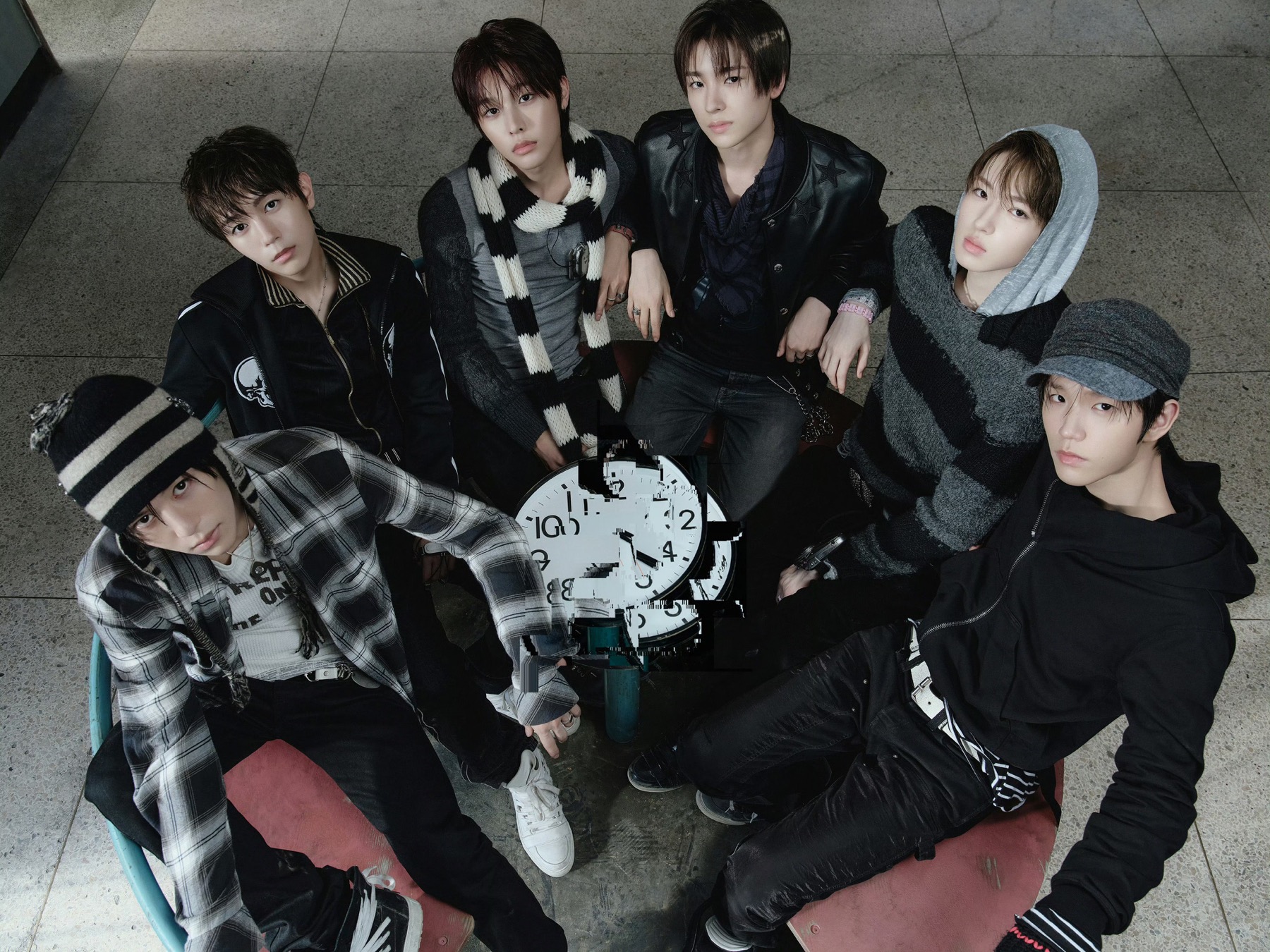
Fig. 01Identity in formation
Defining K-pop
The term “K-pop” may seem straightforward, yet when we
seek to analyse it carefully, we find it difficult to pin down with a single definition.
“Korean” can refer to the nationality of performers, the language of lyrics, the place
of production, or the identity of the entertainment company.
A song in Korean is not automatically K-pop. Many tracks
widely recognised as K-pop feature English lyrics, draw on
musical genres that originated outside South Korea, and involve international songwriters
and producers. Groups such as TWICE and NCT also include members from diverse national and
cultural backgrounds.
This has given rise to two distinct interpretations. On one hand,
K-pop can be understood as Korean culture, organised through
South Korean entertainment agencies, trainee systems and performance conventions. On the
other hand, it can also be seen as global pop music, for its sound, performers, creative
labour and audiences all cross national borders.
The real question, therefore, is not simply whether K-pop
contains Korean or foreign elements, but how these elements are formed, structured, and
invested with cultural meaning.
04 / The K Centre
Chapter two
The “K” Centre
Industry, Training and Performance
Listening study / 15 tracks
Walk
NCT 127
01 / 15
Playback is provided by Spotify. Full-track availability may depend on the visitor’s
region and Spotify account.
If K-pop does not always sound Korean, where is the “K”?
K-pop frequently draws on hip-hop, R&B, electronic
dance music and other transnational popular music genres. Its songs may also be produced
with the involvement of international composers and contain substantial English lyrics.
If we listen only to the music itself, many K-pop tracks do
not necessarily carry an instantly recognisable “Korean sound”.
Keith Howard’s research on South Korean popular music of the 1990s demonstrates that the
development of South Korean pop has always involved the absorption and reinterpretation
of foreign musical forms. After international genres such as rap, hip-hop and dance music
entered South Korea, they forged new connections with the Korean language, youth culture,
televised performances and the local music industry
.
Accordingly, the overseas origin of a musical genre does not mean the final work loses
its Korean identity. Musical genres can cross national borders, yet the process through
which they are selected, recombined and endowed with meaning in South Korea also forms
the cultural identity of the work.
This prompts us to reframe our question: instead of merely asking “What does
K-pop sound like?”, we should ask “How, where and through
what systems is it produced?”
These images feature interactive comeback-concept websites created for
K-pop groups. Select P1–P3 to explore the original
experiences.
Select a window to bring it forward; select it again to visit.
The company does not simply release the music.It organises the system around it.
South Korean entertainment companies typically do not merely handle distribution
after a song is completed. They coordinate group member recruitment, systematic vocal
and dance training, song selection, music production, choreography, stage performance,
styling, visual concepts, promotion and fan engagement.
Companies do not necessarily complete every creative task in-house. Songs may be
written by foreign composers, choreography crafted by international dancers, and visual
design produced by various creative teams. Nonetheless, entertainment agencies select,
coordinate and assemble these resources, integrating them into artists, groups or
comeback concepts with a cohesive identity.
K-pop is therefore not simply a musical genre identifiable
by its melody. It is also an audiovisual performance system that brings together sound,
bodies, dance, costumes, imagery, personas and fan culture. Some companies even produce
short films exclusively to introduce comeback concepts, as seen in aespa’s
SM Culture Universe
(ep.1 “Black Mamba” ↗).
John Lie argues that K-pop cannot be simplistically regarded
as a modern iteration of traditional Korean music. In terms of musical structure, use of
English, choreography and visual aesthetics, K-pop maintains
clear connections with global popular music. Its “K” does not necessarily signify
traditional ethnic characteristics that can be directly heard in the melody.
Lie also observes, however, that K-pop’s success is deeply
intertwined with South Korea’s cultural industries. Korean agencies pursue explicit
commercial and international objectives, organising diverse resources through training,
music production, choreography, stage design and marketing into cultural commodities that
circulate domestically and internationally
.
This suggests that the “K” in K-pop can be understood as an
industrial hub. International sounds, global creators and performers of different
nationalities may enter this system, yet they remain largely selected, organised, packaged
and disseminated through the South Korean entertainment industry.
Entertainment companies produce not only music but also artists’ public personas. Heather
Willoughby’s research on femininity in South Korean popular music demonstrates that
costumes, bodily movements, character personas and stage presentation are not decorative
extras attached to music; instead, they are deliberately designed and marketed content
.
Distinct outfits, makeup, choreography and cinematography can frame the same artist as
youthful and innocent, mature, elegant or rebellious. Audiences encounter not just songs,
but also the visual concepts and performative identities constructed by agencies around
those songs.
Accordingly, K-pop’s identity resides not only in recorded
tracks but also in music videos, live stages, promotional photos, music shows, social media
and fan interactions. In other words, the “K” of K-pop is also
an institutional practice that structures ways of seeing and performing.
05 / Case study 01
01 / 04
Select the portrait to move through the stack. Swipe on touch screens.
Case 01 / Taeyeon
TAEYEON: From Idol Training to Individual Artistry
Taeyeon is chosen because her career has not been confined to a single fixed form of
K-pop. She first debuted as a member of Girls’ Generation,
with her identity rooted within the group; later, she developed a solo career centred
on her own vocal timbre and emotional expression. Her experience allows us to pose a
more nuanced question: if an artist moves away from the sound and image of her original
group, what keeps her still connected to K-pop?
Taeyeon debuted as part of Girls’ Generation in 2007 and officially launched her solo
career with I in 2015. This was more than a simple shift from group promotions
to releasing solo music. During her time in Girls’ Generation, her identity was tied to
the group’s name, concepts and collective image. As a solo artist, audience attention
turned instead toward her voice, emotions and individual interpretation of songs.
On the surface, this shift might seem to weaken her ties to the idol system. Yet her
solo work also demonstrates this system’s strong adaptability. Rather than requiring
Taeyeon to remain locked into one role forever, the system first presented her as a
group idol, before repositioning her as a solo vocalist. As Taeyeon’s image transformed,
she did not step outside the bounds of K-pop. Instead, the
boundaries of K-pop expanded to accommodate her new identity
(Official profile ↗).
Taeyeon’s K-pop identity, therefore, cannot be located within
a single musical style alone. This identity also emerges from how audiences come to know
her. Her solo career is built upon the skills, reputation and fan bonds she established
during her Girls’ Generation era. Even as her music changes, this professional history
endures.
This is not to say, however, that Taeyeon’s identity is entirely constructed by her
agency. Her distinctive voice and characteristic mode of emotional delivery have also
shaped the direction of her solo music. Her case is thus not merely a story of “corporate
control over artists”; it is an ongoing adjustment between opportunities afforded by the
industry and the artist’s own capacities.
Taeyeon’s trajectory illustrates that the “K” in K-pop can
manifest as a professional persona and a cultural biography. Even when an artist’s sound,
visual image and performance style evolve, that history remains attached to her.
K-pop can therefore encompass both group identities
collectively forged by multiple members, as well as more individualised artistic identities.
06 / Case study 02
01 / 07
Select the image to move through the stack. Swipe on touch screens.
Case 02 / fromis_9
fromis_9: When Idol Production Becomes Television
The significance of fromis_9 lies in how the group lets us watch
K-pop being “made” right in front of us. Its members were
chosen through Idol School, a show broadcast on Mnet in 2017. The programme
turned training, assessments and eliminations into television entertainment. This case
thus lays bare a process usually kept hidden inside entertainment companies: how the
industry decides who is fit to become an idol.
On Idol School, the contestants were called “students”. They took classes, put
on performances, and went through constant evaluations and rankings. At the end, nine
contestants were picked to form fromis_9. The group then performed their pre-debut track
Glass Shoes and officially debuted in January 2018 with the mini-album
To. Heart
(KBS World ↗).
The “school” format made the show look like a story about growth. Viewers watched
contestants learn, make mistakes, and work hard to become better idols. At the same time,
however, the show also taught viewers how to judge an idol. Singing, dancing, appearance,
personality, and the ability to win support from audiences all became standards that
could be compared and ranked.
Seen this way, Idol School trained not only the contestants but also the viewers.
It guided the audience to see certain qualities as what an ideal idol should have, and
helped them form emotional bonds with particular contestants. Even before fromis_9
released official albums, future fans were already backing the members. In other words,
while building the group, the show was also building its future audience.
This makes viewer voting especially important. Voting made audiences feel like they were
directly taking part in deciding the final lineup of the group. Still, the show was later
confirmed to have rigged its results, and the producers involved were sentenced
(Yonhap News Agency ↗).
This was not the fault of fromis_9’s members, yet it shows that viewer power has limits.
Audiences were encouraged to believe they were choosing who would debut, but the show’s
producers still controlled the content, editing and final outcomes. Viewers invested their
attention and feelings, yet they did not get decision-making power matching that investment.
This matters because popular music is built on trust. Fans spend time, feelings and even
money because they believe their support counts. When this participation is manipulated,
the issue is no longer just whether a reality show is fair. It becomes a question of who
holds power over both performers and audiences.
Therefore, fromis_9 shows that the “K” in K-pop stands not
only for a production system, but also for the power to decide: who gets to be seen, whose
story catches the audience’s eye, and who finally gets the chance to debut.
07 / Chapter conclusion
Chapter 02 / Conclusion
The “K” as a System of Power
The Korean core of K-pop is not cultural purity,
but the power to organise, shape and decide.
Defining the “K” as the production system of South Korean entertainment companies
cannot answer every question. A company may be based in South Korea, yet the music,
technology, creators and markets it works with can be highly international. At the same
time, crediting all creativity to the company can overlook the contributions of
songwriters, choreographers and the artists themselves.
So this industrial centre is not a fixed, absolute definition. Instead, it is one of the
main ways to explain the Korean identity of K-pop. It shows
how global resources are put together, but it does not prove that K-pop
is culturally pure or a completely closed-off form of Korean music.
Howard points out that South Korean pop music has always grown by taking in and reworking
international music styles. Willoughby shows that visual images and performance identities
are also carefully designed and promoted. Lie links K-pop to
South Korean entertainment agencies, export industries and national branding.
Taeyeon and fromis_9 show two different kinds of power inside K-pop.
Taeyeon’s case demonstrates that the system can adapt and redefine an artist when she builds
a new identity separate from her original group. fromis_9, meanwhile, shows that long before
a group officially debuts, the industry is already shaping both the performers and their audience.
For Taeyeon, the key question is how much room a well-known artist can make for herself.
For fromis_9, the key question is who gets to decide who receives the chance to debut.
Taken together, these two cases show that the Korean core of K-pop
is not just where companies register their businesses or where trainees practise. More
importantly, it is the ability to shape artists’ careers, steer public attention, and decide
who gets accepted as a K-pop artist.
08 / The Global Network
Chapter Three
The Global Network
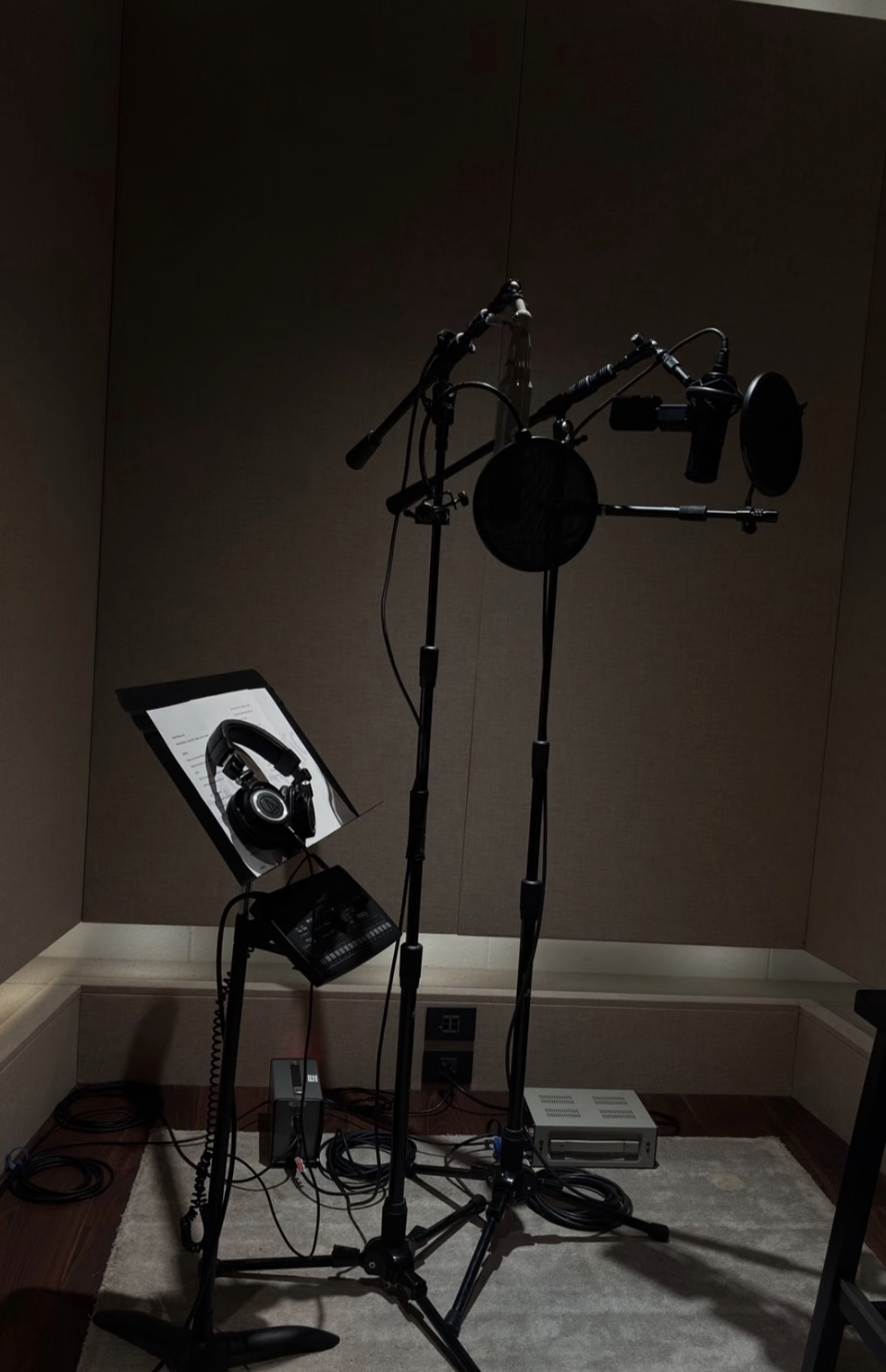
Fig. 05Recording studio
01 / Production across borders
Where does a K-pop song begin?
A K-pop track may be released by a South Korean entertainment
company, produced with creators from Sweden, the United Kingdom, the United States or Norway,
and performed by members from South Korea, Japan, China, Taiwan or Canada. It may draw on
hip‑hop and R&B rooted in Black American music, mix in English or Japanese lyrics, and finally
be watched and shared by audiences across the world via global digital platforms.
Given this production chain that crosses many countries, it becomes difficult to define
K-pop as belonging to a single nation. The sound of the song,
its creators, performers and audiences may all come from different places, yet these separate
pieces are gathered under one cultural label: K-pop.
This is not just a question of how to categorise music. It is also about how South Korea
builds its own cultural identity while drawing on global musical resources.
If we only see K-pop as a Korean success story, we risk overlooking
the contributions of foreign songwriters, Black musical traditions, multi-national members and
global fans. On the other hand, if we simply call it “borderless pop music”, we ignore the role
played by South Korea’s entertainment industry in organising all these resources.
09 / K-pop Without Borders
People behind the network
K-pop Without Borders
Rotate the globe to trace how idols, songwriters and producers move through the
network that becomes K-pop.
Seoul
Drag to rotate · Scroll to zoom · Select a point
Idol line-ups are organised from current artist pages and official group profiles from
SM,
YG,
JYP,
and HYBE.
This map is not a complete census of every K-pop idol, songwriter or producer.
10 / Global genres, new combinations
02 / Sound and language in circulation
Global genres, new combinations
K-pop does not have one fixed genre that belongs only to itself.
It can combine hip-hop, R&B, house, EDM, rap and electronic pop within the same album or
even the same song.
Roald Maliangkay points out that K-pop sound often blends genres
such as R&B, rap, electronic and house, yet its appeal also comes from synchronized
choreography, styling and high-quality music videos. In other words, musical genres are only
one part of K-pop; how these genres are turned into stage and
visual performances matters just as much
.
Therefore, the fact that K-pop uses global music genres does not
mean it simply copies Western pop music. Once a sound enters K-pop,
it is usually recombined with group line distribution, dance, camera work, costumes and fan
engagement. It is not just the music that gets borrowed; it also takes on new functions in
this new context.
Korean, English and Japanese in K-pop lyrics do not only help
audiences understand what the song is about. Language also shapes which audiences the song
tries to reach and what image the artist wants to present.
Jin and Ryoo have studied the mix of Korean and English in K-pop
lyrics. They argue that this language mixing helps K-pop create a
sound that feels both local and global at the same time. Short English phrases are easy for
listeners across different countries to remember and can also make songs feel more international
.
Still, using English does not always mean equal cultural exchange. English carries greater
influence in global business and pop music. For this reason, using English can sometimes show
how K-pop adapts to existing formats to break into international markets.
Lyrics deserve our attention, then, not only because of “what they say”, but also because
language choices reveal who the song is addressing, which markets it aims for, and which kinds
of sound are seen as having global appeal.
03 / Film, fandom and cultural circulation
A music video can contain more than one cultural world
K-pop’s global connections are found not only in its songs and members’
nationalities, but also in its music videos. Ute Fendler notes that K-pop
music videos often adopt the story structures, visual symbols and filming styles of Western films,
while placing these elements within the performance setting of South Korean pop music.
This is not a straightforward copy of any single film. When different films, music, dance and visual
styles are combined in a music video, they can create new connections and meanings. K-pop
is therefore more than just transnationally produced music; it is also a visual form where different media
and cultural traditions interact
.
This also explains why K-pop cannot be analysed only through audio. A viewer’s
understanding of a song can be shaped by choreography, outfits, sets, editing and film references all at once.
K-pop’s global reach does not end once a song is released. International fans buy
different album versions, collect photocards, learn the dances, make translations, join online discussions,
and connect with other fans through social media.
Maliangkay points out that collecting music is about more than simply owning merchandise. What people choose
to collect can also show their tastes, identities and social bonds. For international K-pop
fans, albums and merchandise can be a way to connect with artists, other fans, and this cross-border culture
.
The value of pop music, then, does not only lie in whether its lyrics are “deeply meaningful”. It also lies in
its power to help people form relationships, express who they are, and build communities. K-pop
is worth studying because it lets people from different countries build emotional and social bonds around the
same cultural product.
Michael Fuhr argues that K-pop is a cultural space shaped by both globalising forces
and South Korean national forces. On one hand, it relies on cross-border music production, foreign creators and
global markets. On the other hand, these global resources are used to build South Korea’s cultural industry and
national image
.
These two forces do not hold each other back. The more K-pop draws on global resources,
the better it can reach different markets. Yet its global success may also be reframed as part of South Korea’s
cultural achievements.
This means “global” and “Korean” are not two separate options where you have to pick one. They exist together
within K-pop. Sometimes they support each other, and sometimes they create tensions
around belonging, creative credit and cultural power.
A world map would show that K-pop’s genres, creators, performers and audiences are
spread across many countries. Jin and Ryoo explain how mixed language use gives K-pop
both local and global qualities
.
Fendler shows how music videos link different film and visual traditions. Maliangkay reminds us that global fans
do not just passively consume the music — they build their own identities and communities through collecting and sharing.
These global links do not erase the “K” in K-pop automatically. Instead, they make the
“K” more complicated. K-pop depends on global creativity, yet it gains its name, structure
and brand through South Korea’s cultural industry.
K-pop can therefore be understood as global pop music — not because it has broken
completely away from Korea, but because this Korean industrial centre itself operates through global networks.
12 / Case Study: TWICE & MISAMO
Case study / membership, language and market
Case Study:
TWICE & MISAMO
Choosing TWICE and MISAMO because they make for a really clear comparison. The three members of
MISAMO — Mina, Sana and Momo — are also in TWICE. That means the two groups share the same members,
same agency, and same existing fanbase, yet they are noticeably different in lineup, main language,
brand identity and target market.
This connection lets us compare different factors side by side. If members shift from a multinational
group to an all-Japanese sub-unit, if the main language switches from Korean to Japanese, and if the
primary market moves from South Korea and the global stage to Japan, does this music project stop being
K-pop and become J-pop instead?
01 / TWICE — one group, two markets
TWICE: one group, two markets
TWICE is a typical K-pop girl group. Its members were put together through
JYP Entertainment’s audition and training system. They rose to fame following the standard
K-pop formula: debuts and comebacks in South Korea, appearances on Korean music
shows, live performances and fan promotions. Their music draws on pop styles from all over the world, and
not all members are Korean. Even so, all these pieces were first put together as “TWICE” within the South
Korean idol industry
.
That’s what makes TWICE meaningful. It shows us that a “K-pop group” is not the
same thing as a group made up entirely of Korean people. The “K” in K-pop for TWICE
does not mainly come from every member sharing Korean nationality. It comes from the South Korean entertainment
system that shaped the group, trained them, produced their music and ran their promotions.
This does not mean members’ nationalities do not matter at all. Mina, Sana and Momo being Japanese helped TWICE
reach the Japanese market more smoothly. Within the group, they also act as a bridge between different cultures
and audiences. Joining the Korean system did not make them give up their original cultural identities. Rather,
their Japanese backgrounds were kept and folded into TWICE’s K-pop identity.
This means TWICE’s multinational makeup does not erase its Korean roots. On the contrary, international members
are one of the ways Korean entertainment companies build global appeal. TWICE shows that K-pop’s
global reach does not have to come after the music becomes popular. It can start as early as when members are picked
and the group is formed.
TWICE’s title tracks usually come in two versions: Korean and Japanese. This lets the same song reach audiences in
a new language and market. The group also releases Japanese albums made specifically for Japan. The core melody,
members, choreography and group concept stay consistent, while only the lyrics and target audience shift. This
shows that language changes how a song connects with listeners, but it does not automatically change the group’s
overall identity. Putting out Japanese versions is how K-pop groups localise for Japan:
the core group identity stays intact, while language and promotion are adjusted for local fans
.
If language alone decided what genre the music belongs to, Japanese versions would instantly turn from
K-pop into J-pop. That is not how fans and the industry
see it, though. These Japanese releases are still treated as K-pop activities by TWICE
in Japan, not brand-new works separate from their Korean career.
TWICE’s Japanese title releases laid the groundwork for the Japanese debut of its sub-unit MISAMO. If switching a
song from Korean to Japanese is not enough to turn TWICE into J-pop, does the label shift
more clearly when the Japanese members form their own sub-unit, release original Japanese songs and focus mainly
on the Japanese market?
02 / MISAMO — a Japanese centre inside K-pop
MISAMO: between K-pop and J-pop
The MISAMO unit consists of TWICE’s three Japanese members — Mina, Sana and Momo. It mainly releases
Japanese-language tracks and is clearly targeted at the Japanese market. In terms of members’ nationalities,
lyrical language and target market, MISAMO carries strong J-pop traits.
Even so, MISAMO has not fully broken away from K-pop. The three members first
built their public profiles through TWICE, and the unit remains connected to JYP, the TWICE brand and its
existing fanbase. Do Not Touch is not a brand-new project created by three Japanese artists with no
links to K-pop. Instead, it is a sub-unit that grew out of TWICE’s multinational structure.
Simply calling MISAMO K-pop overlooks its Japanese members, Japanese releases and
Japan-focused market. Yet labelling it purely as J-pop severs its ties to TWICE
and the Korean entertainment system.
MISAMO cannot be defined only by the fact that all three members are Japanese. Otherwise, we run into a
contradiction: Mina, Sana and Momo are recognised as K-pop artists when they are
in TWICE. Why would their nationality suddenly become the deciding factor once they form MISAMO?
What changes is not their nationality — they were already Japanese while in TWICE — but the role their Japanese
identity plays within the group. As members of TWICE, their Japanese background is one part of a multinational
lineup. As MISAMO, their Japanese identity sits at the centre of the unit’s name, member makeup and market positioning.
MISAMO’s songs are primarily in Japanese and made for the Japanese market first, which clearly strengthens its
connection to J-pop. Still, language and market show who the music speaks to; they
cannot fully explain where the work originates.
If we categorise music based on language alone, all of TWICE’s Japanese releases would automatically count as
J-pop. But the Japanese version of TT that came out earlier still keeps
TWICE’s group name, choreography, music and established K-pop public identity. This
shows that using Japanese can sharpen its positioning for Japanese audiences, but it does not erase the artists’
existing K-pop history.
The difference between MISAMO and the Japanese version of TT is that MISAMO is not just re-recording an
existing song in translation. It has a new unit name, puts out original Japanese music, and develops a relatively
separate visual concept. Its Japanese identity therefore runs deeper than TWICE’s regular Japanese releases, yet
this new identity is still built on the fame, resources and fanbase that TWICE provided.
MISAMO’s Do Not Touch works as our key case study. It is not just a translated version of a Korean TWICE
track; it is an original release designed to establish MISAMO’s independent identity. Its associated mini-album is
officially labelled “JAPAN 1st MINI ALBUM”, which clearly marks its place within the Japanese market
.
The art gallery and artwork imagery in Do Not Touch frames the three members as figures to be seen and
admired, yet not casually possessed or touched. This visual concept makes MISAMO feel like more than a temporary
side group from TWICE. It is a sub-unit with its own aesthetic and performative identity.
This does not mean MISAMO has left the K-pop system entirely. The project still relies
on the performance skills, public recognition and fan networks the three members gained from their time in TWICE.
So Do Not Touch does not show one cultural identity replacing another. Rather, the same artists, experience
and resources are reorganised into a new identity with a stronger Japanese focus.
Boman’s research helps us understand that TWICE’s activities in Japan are not merely Korean culture being exported
overseas. Japanese members, the Japanese language, the local market and Japanese fans all take part in shaping the
group’s identity
.
MISAMO takes this localisation a step further. It goes beyond translating TWICE songs into Japanese, creating a
new unit name, musical style and visual identity. It therefore holds both its TWICE/K-pop
career history and its fresh identity within the Japanese market.
The most sensible conclusion is not to force MISAMO into only one category. Instead, we can understand it as a
hybrid product that sits between K-pop and J-pop.
13 / Case Study: NCT
Case study / a global system by design
Case Study:
NCT: Globalisation by Design
Unlike K-pop groups that expanded internationally after becoming successful,
NCT was designed as a global project before its debut.
In 2016, SM Entertainment introduced NCT as “Neo Culture Technology.” The original plan imagined flexible
membership, units based in different cities and content adapted for different languages and markets. Rather
than simply exporting completed Korean products, SM aimed to localise its methods of casting, training,
production and marketing.
NCT / ONE BRAND, MULTIPLE CENTRES
A group or a system?
Each NCT unit destabilises a different way of defining popular music.
Unit
Changing element
Central question
NCT U
Membership
Can a group exist without a fixed lineup?
NCT 127
Geography
Can a Seoul-centred group be simultaneously global?
NCT DREAM
Age and time
Can members “graduate” while the group identity survives?
WayV
Language and market
Can a Mandarin group remain connected to K-pop?
NCT WISH
National market
Is a Korea–Japan unit K-pop, J-pop or both?
Together, the units demonstrate that K-pop cannot be defined through one stable
feature such as nationality, language or location
.
NCT 127: Seoul as the centre
The number “127” refers to the longitude of Seoul. The unit is officially described as being based in South Korea
while operating globally. NCT 127 therefore does not conceal its Korean centre. It presents Seoul as the point from
which global connections are organised.
The “K” does not need to appear as a traditional Korean sound. It can describe the industrial centre that coordinates
international creators, multinational performers and global markets.
NCT U: when the system is more stable than the members
NCT U selects different members for different songs. The lineup changes according to the sound, concept and performance
required. Its continuity therefore comes less from fixed performers than from the NCT brand and production system.
NCT U shows that K-pop identity may exist in the process through which music, performers
and images are organised. It also reveals institutional power: the company decides which member fits a song, which
combinations become visible and how opportunities are distributed.
NCT DREAM: can people be replaced like parts of a system?
NCT DREAM originally followed an age-based graduation system. Members were expected to leave after reaching adulthood,
while younger performers could enter. Theoretically, DREAM could remain permanently young. The members would change,
but the concept would survive.
Members can move, while the system continues.
However, audiences did not experience the members as interchangeable performers. Through music, programmes and years
of shared growth, fans became attached to the relationship between the original seven members. After Mark graduated in
2018, the separation was not understood as a simple administrative change. Fans increasingly identified DREAM with
“7DREAM”—Mark, Renjun, Jeno, Haechan, Jaemin, Chenle and Jisung.
In 2020, SM abolished the graduation system and reorganised the unit around the original seven-member framework
.
This change demonstrates that a company can design a group’s structure but cannot completely control how audiences value
that group. SM originally treated DREAM as a renewable youth concept. Fans treated it as a shared story of seven people
growing up together.
NCT DREAM therefore complicates the idea that K-pop is produced entirely from the top down.
Companies provide structures, but artists and fans create relationships, memories and emotional value that may alter those
structures. Its importance also explains why pop music deserves serious attention. Fans were not responding only to musical
sound. They were responding to ideas of friendship, separation, youth and growing up.
WayV: K-pop or C-pop?
WayV is based in China, performs mainly in Mandarin and addresses Chinese-speaking markets. At the levels of language and
market, it can reasonably be understood as C-pop. However, WayV also belongs to the NCT
structure. Its training history, performance system, branding and institutional relationships remain connected to SM’s
Korean idol model.
WayV can therefore possess different identities simultaneously:
Chinese-facing in language and market;
transnational in sound and creative participation;
connected to K-pop through its institutional history.
Localisation changes the cultural identity of the final product without necessarily removing the Korean institutional centre.
NCT WISH: between Japan and Korea
NCT WISH was created as NCT’s final regional unit. It has a strong Japanese focus but debuted simultaneously in Japan and
South Korea. Japanese members and promotion strengthen its Japanese identity, while Korean training, production and branding
connect it to K-pop. Its identity is therefore produced between markets rather than contained
within one nation.
The end of infinite expansion
SM later ended NCT’s “infinite expansion” and identified NCT WISH as the final regional unit. This decision can be compared
with the removal of NCT DREAM’s graduation system. Both changes demonstrate that NCT is not an automatic or naturally expanding
global community. It is a corporate design that can be introduced, revised and ended
.
Yet DREAM also shows the limit of corporate design: members and fans can generate forms of attachment that make the original
system difficult to maintain.
NCT is not culturally pure Korean music. Its performers, languages, sounds and markets are transnational. However, it is
also not centreless global pop.
Its globalisation was designed through a South Korean entertainment company. SM continues to organise the brand, training,
units and distribution of opportunities. At the same time, local cultures, artists and fans reshape the meaning of what the
system produces.
NCT is globally assembled, locally adapted and institutionally centred in South Korea—but its meaning is also reshaped by
its members and fans.
NCT did not remove the Korean centre. It built a global network around it—but the people inside that network changed how it worked.
14 / Conclusion
Conclusion
What makes K-pop “Korean”?
The website opens with a seemingly simple question:
If a song draws on global pop genres, is made with international creators, features multiple languages,
and is performed by idols of different nationalities, why is it still called K-pop?
From our earlier analysis, we know this question cannot be answered just by listening to the music. A melody
alone cannot tell us where the artists were trained, who coordinated the song, choreography and visual concept,
or which audiences the work mainly targets.
This does not mean classification is meaningless. The labels we give music shape who or which industry we credit
for its success. Calling a work “K-pop”, “J-pop” or “global pop” also changes how we understand its languages,
cultural identities and cross-border collaborations.
So debating whether K-pop is “Korean” is not about searching for some perfectly pure
form of Korean music. The real concern is this: when a pop cultural product involves contributors from many
countries, who organises it, who it represents, and who gains cultural recognition?
Dimension
Korean element
Global element
What does this show?
Industry
Korean entertainment agencies, training and promotion systems
International distribution and cross-border partnerships
Global resources are usually coordinated by a Korean industrial hub
Music
Localised reworking of imported genres
Global styles such as hip-hop, R&B and EDM, plus international creators
The “Koreanness” of K-pop does not equal sonic cultural purity
Performers
Korean idol training and performance conventions
Multinational members
Members’ nationalities alone cannot define a group’s identity
Language
Korean releases and Korean media ecosystem
Japanese, English and multilingual versions
Language shifts the intended audience, but does not automatically rewrite the whole identity
Market
Korean debuts, music shows and promotional platforms
Japanese market and global audiences
K-pop originates in Korea, then adapts locally for different markets
Taken together, K-pop is neither culturally pure Korean music, nor a fully stateless,
centreless global pop category.
Its sounds, creators, members, languages and audiences are increasingly transnational. Yet these resources are
still usually organised through Korean entertainment companies’ systems for training, production, performance,
promotion and branding. The “K” in K-pop therefore describes less a fixed musical
style you can hear directly in the melody, and more an industrial and cultural centre that organises global resources.
This centre is not closed or absolute, however. TWICE and MISAMO show that artists’ identities can be repositioned
as group formations, languages and target markets change. NCT demonstrates that transnationality can even be built
into the Korean entertainment system from the earliest stages of group design. The Korean centre remains, but it
has become more flexible and more dependent on cross-border collaboration.
My final argument is therefore:
K-pop is Korean not because it is culturally “pure”, but because Korea remains the
primary centre that organises its global hybridity.
In other words, K-pop is a form of popular culture produced and circulated through
global networks, with Korea at its centre. It cannot be reduced to traditional Korean music, nor can it be
dismissed as just pop with no special link to Korea.
The question is no longer whether K-pop belongs to Korea or to the world. Instead,
we ask how Korea acts as the centre arranging these global connections — and how those global connections keep
reshaping what the “K” means.